
The notion of a zero-emission superyacht had initially resembled the theme of sheer fantasy, the type of dream that is found in futuristic movies, as opposed to the reality book about the order of things. But today, shipyards in Monaco to the Netherlands are launching vessels that can cross oceans with only a whisper of exhaust and are being powered by hydrogen, giant battery banks and sails that would make a 19th-century clipper captain proud.
It is a silent end of the age of the smoke-belching, fuel-guzzling leviathans, and in their place are floating palaces, which unashamedly indulge extravagance and at the same time take care of the environment. It is no compromise because, to an increasing number of ultrahigh-net-worth individuals, it is now the sole definition of luxury acceptable to them.
The Forces Driving Change
The industry has been subjected to two strong currents that are driving the industry towards sustainability. The first is regulatory. Strict emission limits within a demarcated zone of the sea are being introduced in ports within the Mediterranean, the Caribbean and even the South Pacific.
The 50% reduction in shipping emissions targets by the International Maritime Organisation that come into effect by 2050 are relevant to both cargo ships and yachts, and flag states are starting to implement them. Owners who used to anchor wherever they want are now fined, limited or even prohibited in case their vessels are unable to demonstrate low-impact credentials.
The second one is the current generated by the buyers. They are a new generation of billionaires, most of them under fifty and fluent in the vocabulary of ESG investing; they do not want to have a photo shoot of themselves getting off a floating environmental liability.
They desire the 80-meter beach club, the submarine garage, and the glass-bottomed spa, yet they do not want it to be called the one that is burning the planet on Instagram. To them, the definition of a green superyacht is the ultimate symbol of status and evidence of the possibility of combining wealth and conscience.
How the New Generation is Built
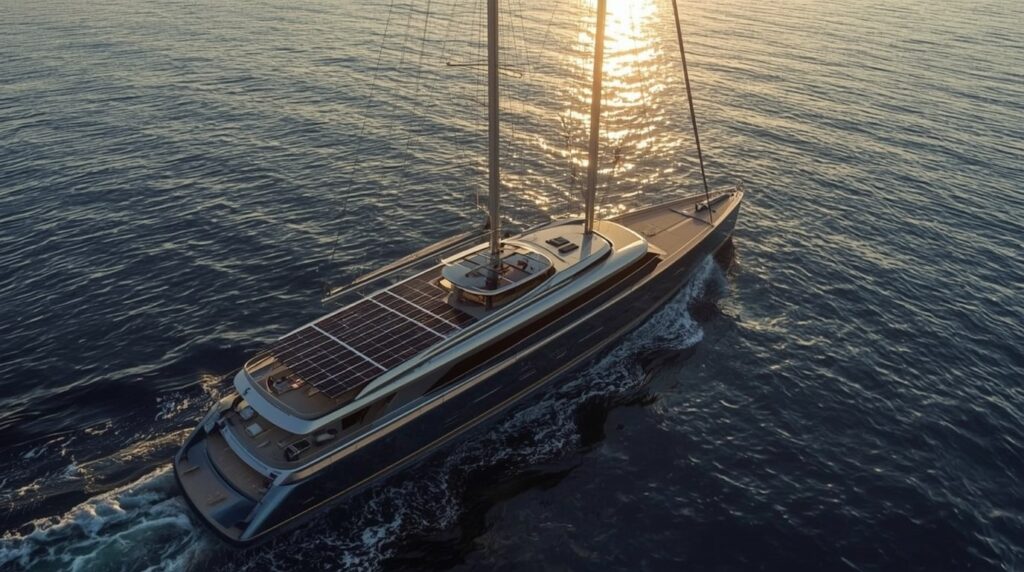
The change starts way before the bottle of champagne smashes on the hull. Naval architects are no longer compelled to casually consider energy efficiency as the main constraint in their designs. Slim hulls that have bulbous bows cut through water with much less resistance. Certain studios are going back to full sailing rigs, not as nostalgic elements but as efficient propulsion systems with 12-15 knots in the trades, supported by electric motors in a dead wind.
The middle groups are occupied by hybrid propulsion. Diesel engines are no longer constantly operating; instead, large lithium-ion battery packs, up to a few times more than 10 megawatt-hours in size, take care of hotel loads and low-speed cruising.
The regeneration is achieved through several sources: spinning propellers when the ship is in sail mode, massive solar skins on the hard tops and deckhouses and more and more through hydrogen fuel cells that give only fresh water as waste. One of these new construction classes can operate up to eight hours on batteries at 10 knots alone, which is sufficient to enter and exit even the most sensitive lagoons without switching on a generator.
The same dramatic change has been experienced in materials. The decades-old superyacht staple of teak decks is being substituted by cork composites, reclaimed tropical woods or synthetic substitutes that appear, but do not have the deforestation footprint.
The interiors embrace the use of bamboo that is fast to renew, recycled aluminium and leather that has been tanned using olive leaves other than chromium. The glue that is used in its construction is also bio-based. What is produced is a yacht which can be deconstructed once the life is finished with significantly less toxic leftovers as compared to its predecessors.
The handling of waste has ceased to be based on crude holding tanks and has become an integrated closed-loop system. Treating Black water onboard Black water is treated to drinking-water standards; grey water is polished and recycled as deck washdown or technical systems.
There are also some ships that have enzymatic digesters that convert food waste to biogas to power the crew galley. Plastics no longer appear in galleys, or even in guest rooms, but are being substituted with compostable or eternal reuse products.
The Ingeniours in the Vanguard
A few of the ships have already left the prototype stage to become icons. Among them is a 90-meter sailing yacht introduced in the Netherlands whose DynaRig sail plan, which was first designed for cargo ships, has a sail cover of over 3,000 square meters and can be deployed by simply pressing a button.
Together with a 1-megawatt hydrogen fuel-cell range extender, she will be able to cross the Atlantic with nothing but a cloud of water vapour. Her owner is a European technology entrepreneur who insists that the guests should not hear the engines; instead, they should hear wind and waves.
One more milestone is the 75-meter motoryacht in explorer style, which was sold to a buyer in Silicon Valley. Her azipod drives generate electricity on the move, and a 3,000-square-meter solar skin generates enough electricity in the tropics to power air-conditioning and desalination without involving the diesel generators.
At the bottom, an exhaust-aftertreatment system absorbs 99% of particulates when the diesels are required rarely. She just finished a Northwest Passage voyage that amounted to a carbon footprint that was lower than the annual driving of most people.
The most audacious project so far may be a 110-meter one, which is being completed in Germany. Her design, based on future fuels, has twin 2-megawatt fuel cells prepared either as green hydrogen or ammonia.
Her waste-heat recovery system finds the heat generated by all processes of this mechanism to heat up the infinity pool and the fireplace in the beach club. She will be the largest zero-emission-capable private ship ever in existence by the time she launches next year.
The New Meaning of Opulence
These yachts are no puritanical penance machines. They still have helipads which can be folded into the deck, a cinema outdoors which lifts out of the superstructure, 5,000 bottle wine cellars and master suites bigger than most apartments.
The difference is in the fact that all luxuries are now weighed against their environmental price, and the most successful designers have found out that necessity is the mother of invention.
The lighting of a beach club full of bioluminescent panels does not require a generator. Nothing is more spectacular than a glass-enclosed spa that has a wall with living corals that are cultivated in onboard tanks.
The division is also redefining ownership economics. Green superyachts, which are currently the most advanced, are able to run on half to two-thirds the operating cost of their traditional counterparts due to lower fuel use and the ease with which an electric drive can be maintained.
Resale values are performing even better, and a five-year-old traditional diesel superyacht is not going to be able to find a buyer in the market in five years’ time, whereas its hybrid or zero-emission equivalent already has offers.
Starting as a regulatory nuisance and a PR tactic, it has turned into something more fundamental, a total reinvention of what luxury on the sea can be. Not yet dead, but doomed to die are the smoke-belching behemoths.
The future is being built in shipyards around Europe, bit by bit, panel by panel, tank by tank of hydrogen, reclaimed beam by reclaimed beam. The last luxury to the affluent is no longer that of the largest size or the quickest speed. It is the one that leaves the oceans as they were.